
Ask the EHSQ Expert
How to Reduce Environmental Risk and Create a Culture of Compliance | 26 pages
Compliance Management
Environmental Management
ESG
eBook I Ask the EHSQ Expert How to Reduce Environmental Risk and Create a Culture of Compliance
Table of Contents Introduction What are the best ways to reduce EHS risk? What are common mistakes when it comes to managing environmental risk? How do I keep up with a changing regulatory landscape? How can I create a compliance-driven culture? How will approaches to environmental compliance change in the next 5 years? 03 04 08 13 18 22
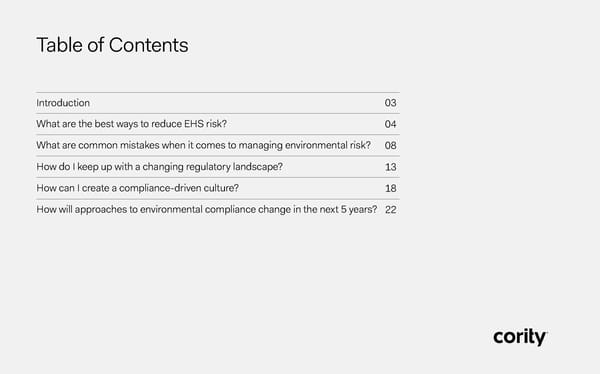
Introduction As environmental performance and financial performance become inexplicably intertwined with the rapid rise of ESG investing, it’s more important than ever for EHS teams to laser focus on the collection, tracking, and reporting of this critical data and lower compliance and business risk across the enterprise. But keeping up with constant regulatory change and proactively identifying issues before they become incidents isn’t easy. That’s why Christine Wyman McCarty, Product Marketing Manager at Cority, teamed up with Meghan Foley, Principal Consultant at Trinity Consultants, to talk about how to create a culture of compliance, strategies to minimize risk (and the most common mistakes to avoid), and what to start thinking about now to prepare for your organization’s ESG reporting initiatives. 3 © CORITY SOFTWARE INC. Meghan Foley Principal Consultant, Trinity Consultants Christine Wyman McCarty Product Marketing Manager, Cority
Question 1 What are the best ways to reduce EHS risk?
Question: What are the best ways to reduce EHS risk? Christine: ISO 14001 offers a framework many organizations use to minimize environmental impacts and comply with applicable laws, regulations, and other environmental requirements. ISO has issued over 300,000 certifications and many more organizations are working toward ISO 14001 certification to continually improve environmental performance. Being ISO certified can be a market differentiator that demonstrates your organization’s commitment to environmental stewardship, but the standard itself can also be beneficial for general planning guidance – even if you never intend to obtain a formal certification. The ISO 14001 standard suggests a Plan, Do, Check, Act model as well as a preliminary gap analysis to define all elements of your operation that will interact with the environment and assist in establishing measurable objectives, goals, and targets. P C D A Planning Performance Evaluation Support & Opperation Improvement Leadership Context of the Organization: Internal and External Issues Needs & Expectations of interested parties Scope of the environmental management system 5 © CORITY SOFTWARE INC.
Risk can’t be reduced unless it’s identified and mitigation plans are put in place. There will always be some risks that can’t be anticipated or prepared for, but in most organizations, there are many EHS-related risks that can be easily identified including: › Financial risks › Operational risk › Security risks › Risk of harm to employees, communities, and the environment Compiling your known risks, assessing the potential impacts, and estimating probabilities of occurrence enables you to prioritize the risks that are most likely or most costly so you can allocate resources to mitigating the largest risks in your organization. Meghan: For many companies, it’s a struggle to proactively identify issues and challenges before they present risks to the environment, employee health and safety, and the business. In addition to following the ISO 14001 framework like Christine suggested, another way to reduce both EHS and business risk is to leverage technology like EHS software as it enables process automation, accountability, and greater insight into data and activities. For example, if your company uses integrated solutions for the following activities, it’s possible to assign compliance activities to accountable personnel, facilitate documentation and completion of the activity, and assess the effectiveness of your programs all in one place: › Compliance Calendar and Actions Tracking (preventive, corrective, or other actions) › Audits and Inspections › Incident Management and Root Cause Analysis › Management of Change (MOC) › EHS Risk Assessments › Behavioral-Based EHS and Near-Miss/ Concern Reporting › Training and Competency Management › Environmental Data Management (emissions, quantities, limits, thresholds, etc.) 6 © CORITY SOFTWARE INC.
› Safety and Occupational Health Data Management › EHS Data Analytics (emissions, performance indicators and metrics, limits etc.) As more companies work toward building integrated EHS programs that are comprehensive, automated, and routinely assessed, the risk of unknown requirements, inaccurate reporting, or accidental releases diminishes. 7 © CORITY SOFTWARE INC.
Question 2 What are common mistakes when it comes to managing environmental risk?
© CORITY SOFTWARE INC. Question: What are common mistakes when it comes to managing environmental risk? Meghan: Most companies want to know, -- “How are we doing with compliance?” -- Some organizations rely on past performance to answer that question, assuming that no incidents means they are doing well or that an accidental release indicates they are not doing so well. In practice, the question -- “How are we doing with compliance?” -- often relates to how well an organization routinely evaluates applicable regulations, EHS activities and documents, and EHS risk. Some of the most common mistakes we see that lead to greater EHS risks are: › Trouble keeping up with change – changing regulations, site conditions, documentation, and personnel. › Assuming a lack of incidents, notices of violations, or fines means things are being done correctly and the organization is in compliance. 9
› Failure to understand how to assess, mitigate, and manage risk effectively. For example, many organizations we speak with struggle to keep SDS documentation current as products are switched out or SDS are versioned. Implementing robust chemical management programs, routine review of SDS records, and use of a digital tool to manage SDS documents all help reduce this type of EHS risk. Another example we often come across: organizations struggle to remember to review and update SPCCs as the sites change, or they don’t realize that once the site begins to store items in outdoor areas, they might become subject to stormwater permitting requirements. When companies start to realize these common mistakes cause risk to the business, systems and processes can then be put in place to help prevent these errors and reduce EHS risks. Christine: When it comes to environmental risk mitigation mistakes, a few themes come to mind: Taking a siloed approach Environmental management can be very complex and the potential environmental consequences of normal business and operating decisions may be difficult or even impossible for other departments to accurately assess. The expertise offered by EHS professionals is critical in understanding the full picture. It’s imperative to create strong cross-functional communication across relevant teams in order to embed EHS thinking across the enterprise. From procurement to operations to facility management, various teams are making decisions with environmental consequences. For example, when developing new products or services, environmental staff can identify ways to improve the product or the production process so there’s less waste – or less cost in disposing of the waste created. 10 © CORITY SOFTWARE INC.
© CORITY SOFTWARE INC. Another example: if operations is putting in a new above ground storage tank, the environmental team may have data that demonstrates what size tank is needed to save space, save money, and stay in compliance with waste regulations. A new tank may also necessitate updating an SPCC plan or increasing the holding capacity of a secondary containment area. If other teams include environmental professionals from the beginning, you can reduce the risk of last-minute changes and potential non-compliance events. Taking a Set It & Forget It approach If your company has a robust environmental risk assessment practice in place and is executing against identified tasks, it may be tempting to think you’re in the clear. But don’t forget to regularly review the plans you’ve created and re-assess whether any material factors have significantly changed. Incorporating continuous improvement into your environmental programs provides 11
opportunities to identify additional gaps and areas for improvement. It’s worth mentioning that it’s also a good idea to step out of your routine operating rhythm and evaluate and assess whether any factors have changed at some regular cadence, potentially at the six or twelve-month mark. Use this opportunity to determine if any circumstances have changed that would require you to re-evaluate your current compliance plans. A few questions to ask yourself: › Have new risks arisen? › Has staff turnover created knowledge gaps? › Have operating processes changed? › Are there new obligations on the horizon? › Have market factors shifted in a significant way? When companies install a new piece of equipment, they often go through rigorous Management of Change processes to ensure risks are identified and accounted for. Using a similar, careful, rigorous Management of Change mindset when it comes to your business and environmental planning can help ensure that the cumulative impact of small changes is evaluated. In 2020, a large asset management firm took voting action against 53 companies and told 191 more they were on watch for “making insufficient progress integrating climate risks into their business models and/ or disclosures,” which has presented a rapid market shift for companies looking to gain access to investor capitol, particularly in the European Union. As a cautionary tale: in the United States, seven large utility companies were charged with violating the Clean Air Act , including one company who received a Notice of Violation and a $14 million fine for making a series of small changes to their operating equipment, with the EPA ruling that the cumulative effect of the changes required they get a New Source Review permit. 12 © CORITY SOFTWARE INC.
Question 3 How do I keep up with a changing regulatory landscape?
© CORITY SOFTWARE INC. 14 Question: How do I keep up with a changing regulatory landscape? Meghan: The constant change in regulations, site conditions, products, and materials, as well as other factors, often present EHS teams with the challenge of trying to, “know what I don’t know.” The risk of non-compliance with unknown regulations can be mitigated in several ways: › Automated and routine inspections and audits, and regulatory applicability reviews (legal register or regulatory matrix reviews) allows for the site to be evaluated against regulatory requirements. › Management of Change processes -- for activities, equipment, products, materials, and services -- allows for changes to be evaluated for EHS and risk consequences and necessary actions to be assigned and tracked to completion. They also allow for communication of why a certain change cannot move forward due to EHS compliance or risks. › Concern and question reporting allows
people access to EHS knowledge and expertise to help evaluate, correct, or approve activities, products, and conditions that could impact compliance. › Routine communication and training allows for a culture aware of EHS compliance concerns and risks which helps people think and ask questions before making seemingly small changes that could impact compliance. Organizations are looking to automate workflows, digitize processes, and implement stage-gates to help ease the difficulties that come with trying to keep up with this change. Many companies are taking advantage of remote auditing, digital twin technology (a digital rendering of a facility made from tablets or professional imaging service companies), and digital solutions to help identify changes at the site that could impact applicable requirements. Services for regulatory updates and applicability notes are available to help companies track new and changing regulations applicable or relevant to them. Finally, automated tools like Chemical Approval and Management of Change solutions help companies review and approve new/modified activities, products, equipment, and materials before they are implemented, which provides EHS leaders the opportunity to evaluate and complete required activities and maintain compliance. For example, an MOC for a boiler with automated review by EHS would allow for the necessary air permits, safety procedures, and routine inspection to be obtained, documented, and rolled out to avoid any issues related to unknown air permit compliance or energy isolation procedures being outdated. Christine: Like Meghan mentioned, keeping on top of regulatory changes is a common struggle. Fortunately there are a lot of resources out there to help EHS professionals stay up to date. Industry groups are an excellent resource for understanding not only what potential regulatory changes are on the horizon, 15 © CORITY SOFTWARE INC.
© CORITY SOFTWARE INC. 16 but also for providing additional context that is relevant for your specific industry. For example, the Retail Industry Leaders Association in the United States has been keeping a close eye on a 2019 EPA rule regarding how and when pharmaceuticals must be categorized and disposed of as hazardous waste - a rule that has a significant impact on many retailers. The International Aerospace Environmental Group is another great example of an industry group dedicated in part to sharing information on industry-wide opportunities to adopt global environmental requirements. Industry groups also often offer opportunities to benchmark yourself against your peers in a variety of ways including the maturity of your environmental programs and your risk tolerance levels, helping you to situate your company within a broader context. Plus, EHS software platforms like CorityOne™ can integrate regulatory content from providers like RegScan and Enhesa to provide a single view of all your compliance
obligations. A unified EHS platform with integrated regulatory content provides information about global regulatory changes, including federal and state regulations and their associated requirements, enabling you to better manage your EHS compliance across jurisdictions. If you have limited time and resources to dedicate to keeping up with these changes, help is out there. Find a trusted partner like Trinity Consultants to help you keep an eye on upcoming changes and provide guidance on updates you may want to consider as a result of regulatory shifts. There’s a variety of great resources offered by consulting groups – from free webinars to paid engagements and ongoing education. These professionals are steeped in regulatory knowledge and can help you assess your own risks and anticipate necessary changes. Staying informed about upcoming changes to existing regulations and to new regulations is critical, of course, but it can also be beneficial to keep an eye on enforcement trends and shifting interpretations regarding existing regulations. When doing a gap analysis and determining the priority of risks to mitigate, an understanding of how existing laws are being enforced across different geographies can be one factor in determining your priority of risks to mitigate. 17 © CORITY SOFTWARE INC.
Question 4 How can I create a compliance-driven culture?
© CORITY SOFTWARE INC. 19 Question: How can I create a compliance- driven culture? Christine: Safety managers have been asking this question for decades, but environmental activities can still be viewed in a more reactive way. Fortunately, there are signs that employees and companies are more open now to making environmental performance part of everyday culture. We’re seeing generational shifts in the workforce and there’s a growing desire among younger workforce members to work for a company whose values align with their own, which often means working for greener, safer companies with strong ESG performance. Companies are examining their own environmental footprint and looking for ways to meet zero waste goals, ambitious carbon reduction targets, and improve overall environmental performance. Given the public visibility of these pledges and increasing interest in sustainability and ESG reporting , senior leadership is throwing support behind initiatives to educate employees about ways to
reduce environmental impact, from reducing food waste in cafeterias and canteens to investing in innovative technology that will help reduce emissions. As awareness of the central role that ESG plays in gaining access to investor capital escalates, industry experts are anticipating that more senior leadership will promote greener thinking in their own businesses. When it comes to creating a culture of compliance, getting buy-in from the folks on the frontlines who are executing on necessary tasks is critical – but we know that compliance tasks can often be complex and difficult especially if you aren’t immersed in deep environmental expertise. Technology can play a key role in democratizing compliance and embedding environmental consciousness into everyday activities. For example, if an employee can follow step-by-step inspection guidance with EHS software on a mobile device, the software can simplify the process by presenting only those questions about equipment at that particular facility. Additionally, electronic documentation provides two significant risk-reducing benefits: 1. By keeping critical documents like inspections and waste manifests in a SaaS-based software system, you can always be sure you’ll be able to present necessary documentation to relevant regulatory bodies. 2. Electronic documentation makes it easy to see the status of compliance activities at one location, or across many locations – giving leadership visibility into compliance status at any given moment and encouraging operations to complete regular tasks in a timely fashion. Finally, communicating about the importance of executing on tasks can help build a more participatory culture. We often focus on the details of what, when and how tasks must be completed. These are all critical, of course, but making sure to focus on why these tasks are important can create more operational buy-in. If an operations team knows that incomplete 20 © CORITY SOFTWARE INC.
© CORITY SOFTWARE INC. 21 inspections or missing documentation can lead to large fines and even operating privileges being revoked, they may place higher value on these tasks. Work with your stakeholders to educate them about the importance of their compliance tasks and help them understand why the work they are doing is so critical to the success of the organization. Meghan: Digital solutions for EHS activities and processes can greatly improve your organization’s ability to engage the workforce. Digital solutions enable better assignment, tracking, and follow up for compliance tasks, inspections, corrective actions, incidents, and change management. They also promote the ability for metrics tracking, trend analysis, and sharing of dashboards to let everyone know, “How we are doing with compliance”. The ability to enable concern reporting, automatically notify supervisors and managers of incidents involving their employees, or upcoming compliance due dates, allows for better communication of EHS concerns, questions, requirements, and helps drive identification of areas where progress has been made versus areas that need work.
Question 5 How will approaches to environmental compliance change in the next 5 years – and how can I prepare?
© CORITY SOFTWARE INC. 23 Question: How will approaches to environmental compliance change in the next 5 years – and how can I prepare? Meghan: As the world continues to further evolve into a more digital future with hybrid work environments, organizations will look to automate and digitize more and more EHS processes over the next five years. Due to the changing corporate landscape and investor pressure, more emphasis will be placed on the collection, tracking, and reporting of ESG data, and the use of artificial intelligence (AI) and augmented reality will be integrated into our EHS processes and analytics. This will enable us to do more with less time, travel, and expenses. It will also demand smarter use of existing technology and perhaps even better technology where existing tools or processes are lacking. Specifically, automated data gathering and analytics around sustainability metrics with automated system flags based on bots or other AI will make consuming, validating, and acting on data easier. Advanced data analytics will support much deeper understanding of EHS data, underlying drivers/correlations, and trends which can drive sharper, more targeted EHS responses, plans, or practices. Finally, remote audits , assessments and tools will help EHS practitioners put more eyes in more places more readily. This will enable EHS teams to better support site practices and improve conditions. Historical challenges and concerns related to user adoption of new technology, software maintenance, and ongoing licensing costs will be far outweighed by the prudent business case to leverage digital tools to accelerate the maturity of EHS programs, provide transparency into ESG data, and lower EHS compliance and business risk across the enterprise. Christine: In the last few years, we’ve seen worldwide interest in ESG investing increase dramatically. In 2020, when the CEO of Blackrock, the world’s largest asset manager indicated that “climate risk is financial risk,” it sparked global awareness that in order
to continue to be competitive in attracting investor capital, companies would need to demonstrate dedication to improving environmental, social and governance outcomes. As ESG reporting becomes more embedded in market expectations, investors are looking more closely at the data, and there is growing anticipation that reporting standards will be consolidated and standardized even further. As ESG data becomes a critical component of evaluating financial returns, many experts are predicting that investors will demand more rigor and auditability in ESG data. Now is a good time to look at your organization’s data collection processes and determine how defensible your environmental data is. A few things to consider: › Do you have an audit trail? › Can you explain the assumptions used to calculate environmental outputs? › Is your data stored securely? As the Biden administration has rejoined the Paris Climate Accord, set a new 2020 carbon reduction target, and made environmental justice a central theme , many experts are anticipating that enforcement of existing regulations will increase in the coming years. Now is an excellent time to evaluate the level of visibility you have into whether your critical compliance tasks are being completed. Additionally, as environmental performance and financial outcomes become intertwined, we may even see environmental-related enforcement coming from agencies outside the EPA. For example, in February, the acting chair of the SEC issued a directive to the division of corporate finance to enhance its focus on climate-related disclosures in public company filings and asked that previously issued guidance from 2010 be updated, citing that “now more than ever, investors are considering climate-related issues when making their investment decisions,” and that the SEC must “ensure that they have access to material information.” Environmental data can’t be viewed in a compliance silo and must 24 © CORITY SOFTWARE INC.
© CORITY SOFTWARE INC. 25 instead be viewed holistically as something that can be used as a key asset across the enterprise. Finally, we are going to continue to see technology rapidly evolve to help make compliance easier. As an example of the rapid shift toward technology, in a 2021 NAEM survey , 97% of survey respondents said they were using virtual auditing or planning to move to virtual auditing in the next year. From remote audits on mobile devices to smart meters and connected workers, we are increasingly going to see greater volumes of data collected, and EHS professionals are going to be expected to manage this data effectively. Technology is a critical component to help manage compliance data in an effective and efficient way and help make sure nothing is slipping through the cracks. If you aren’t already using EHS software, now is a great time to see how it can help you reduce risk and monitor compliance.
ONE ™ Introducing CorityOne™. The human-centered enterprise EHS SaaS platform—designed by industry experts for EHS experts and business leaders to empower healthier, safer, and more sustainable organizations that fulfill the business imperative of building the better enterprise of tomorrow. Schedule a Demo Founded in 1974, Trinity Consultants helps organizations overcome complex, mission- critical challenges in EHS, engineering, and science through expertise in consulting, technology, training, and staffing. We support clients in geographies worldwide and across a broad range of sectors including industrial, energy, manufacturing, mining, life sciences, and commercial/institutional. We help clients achieve compliance with applicable regulations, international standards, and company specifications, enabling them to avoid business disruption, speed products to market, address stakeholder concerns, and achieve business objectives. Learn More It’s time to think differently about the future. © CORITY SOFTWARE INC.